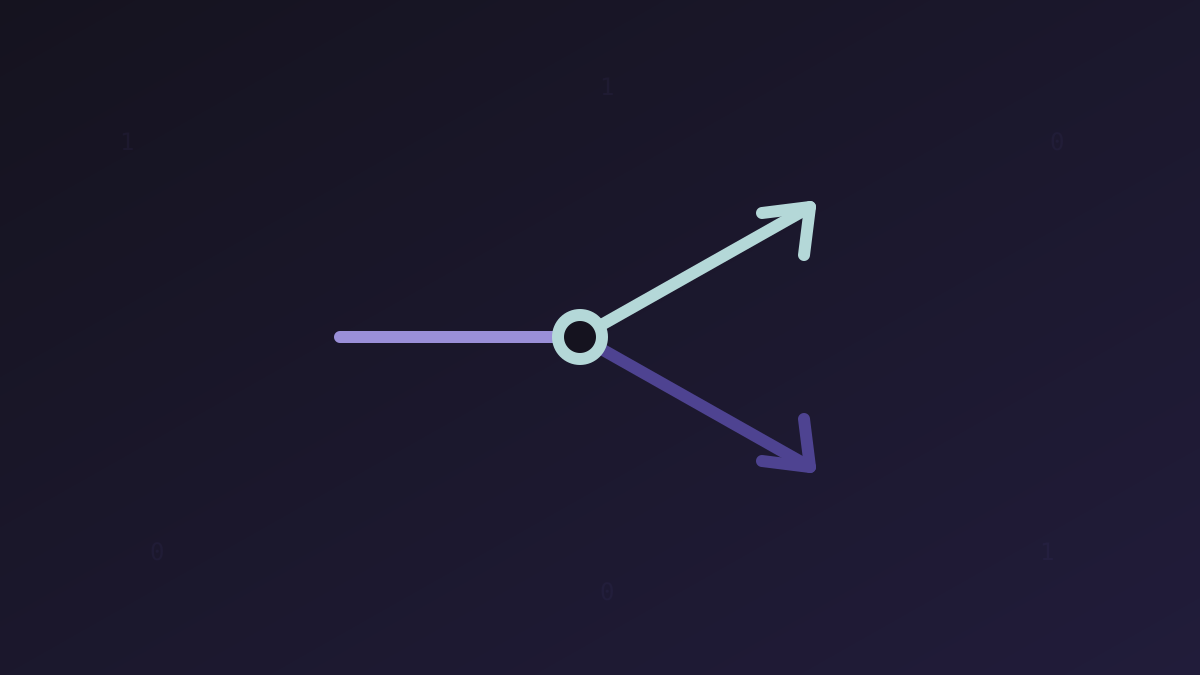

Upgrade or relaunch? Why the real decision has nothing to do with TYPO3 versions
Should we modernise the existing platform, or would it be more economical to start over from scratch?
Insights into our work: TYPO3 upgrades, engineering practices and how we work with agencies.
Should we modernise the existing platform, or would it be more economical to start over from scratch?
When open source is discussed, many conversations focus on new features, security updates or release cycles. It is far rarer to talk about why companies invest time, money and experienced developers at all, even though such investments can seldom be attributed directly to a single client project. This is exactly the question that has occupied us again and again for some years.
In Europe, TYPO3 has been one of the established enterprise CMS platforms for many years. Numerous companies, public institutions, and international corporations rely on the platform because it combines long-term maintainability, flexible permission concepts, and a high degree of adaptability. Outside Europe, by contrast, TYPO3 is still often perceived as a niche product. In our assessment, this is precisely where one of the greatest opportunities for the coming years lies.
Experienced TYPO3 developers are the most valuable technical resource in many agencies. That is precisely why larger upgrade projects raise a question that is discussed surprisingly rarely: is an enterprise upgrade really the task with which these developers create the greatest value for their clients?
Many of the technical challenges of a TYPO3 upgrade can be mastered with experience, tools and a structured process. There is one area, however, where even the best preparation cannot provide a clear-cut answer: the continued evolution of third-party extensions.
A fixed price for a major TYPO3 upgrade sounds contradictory at first. After all, the appeal of a time-and-material project lies precisely in the ability to handle unknown risks flexibly. So why do we still deliberately choose a fixed price in many projects? The answer has surprisingly little to do with costing and remarkably much to do with engineering.
Many companies invest in better developers. We additionally invest in better processes. Both matter, but in our experience lasting quality only emerges when experience no longer accumulates merely in the minds of individual developers, but becomes part of the engineering process step by step.
The larger an upgrade becomes, the more important the question of how to organise the process. After more than 150 TYPO3 upgrades, we have come to believe that many projects become needlessly complicated because they follow TYPO3's upgrade path rather than the architecture of the target system.